
 By Admin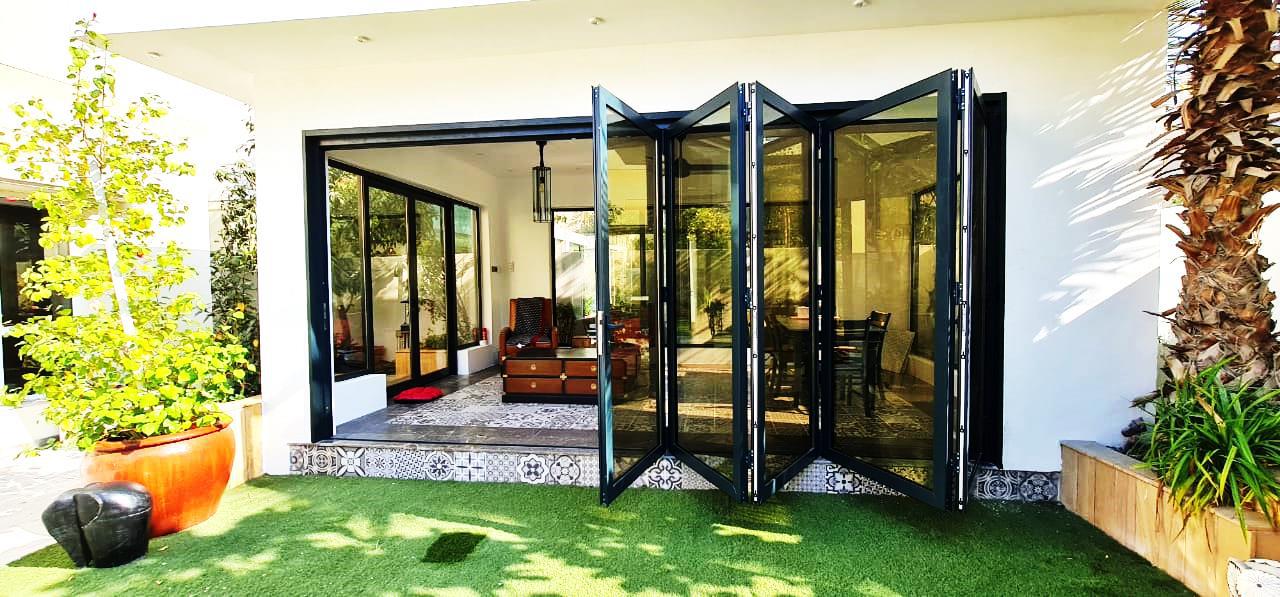
Dubai’s summer is a stress test for any building component. Outdoor temperatures routinely exceed 45°C, coastal air carries salt, and fine dust stays suspended for months. In that environment, an aluminium glass door is not a style preference. It is one of the few framing options that holds its shape, keeps its seal, and resists corrosion under all three pressures at once. Timber swells and warps. uPVC softens and fades under sustained solar exposure. Properly finished aluminium does neither.
How aluminium survives Dubai’s heat and salt
The material’s performance depends almost entirely on its surface treatment. Anodising or powder coating builds a dense oxide layer that reflects UV, resists salt spray, and keeps the frame intact for two decades or more in coastal locations. Untreated steel within five kilometres of the Dubai shoreline shows visible corrosion in three to four years. Correctly coated aluminium does not.
Aluminium’s strength-to-weight ratio matters too. It weighs roughly one-third of steel, yet alloy formulation and profile design can raise bending stiffness by about 30%. That is enough to carry large glass panels without a bulky frame. For Dubai homes that want wide, uninterrupted views, this means slim sightlines without compromising structural safety.
Thermal breaks: the line between a door that works and one that doesn’t
Standard aluminium conducts heat quickly. Without an internal barrier, outdoor heat travels straight through the metal into the room, and the air conditioning has to work harder to compensate. A thermal break solves this by embedding an insulating strip inside the profile, physically separating the interior and exterior aluminium and cutting the direct conduction path.
The difference is measurable in daily use. On a west-facing glass door in Dubai without low-emissivity coating or a thermal break, the glass surface can reach 70°C or higher on a summer afternoon, and the AC system may work 35% to 50% harder than normal. With a thermally broken frame and Low-E glass, that surface temperature drops to 35–40°C, and the cooling load falls by 25% to 40%. The effect shows up on the DEWA bill month after month.
Glass choice determines the other half of performance
Aluminium glass doors in Dubai typically use tempered or laminated glass, and each solves a different problem. Tempered glass is heat-treated for higher strength and breaks into small granular pieces rather than sharp shards. It suits interior doors and partitions where contact is frequent. Laminated glass sandwiches a PVB interlayer between two panes. When it breaks, the fragments stay bonded to the film, so the opening remains a barrier.
For homes near busy roads, laminated glass also performs better acoustically. The PVB interlayer acts as a damping layer, absorbing and dissipating sound energy, which helps reduce traffic noise. It also blocks up to 99% of UV radiation, protecting furniture and flooring from Dubai’s intense sunlight.
Tempered glass is usually cheaper. An 8mm pane runs roughly AED 150–250 per square metre, while 10mm laminated glass (5+5) costs about AED 400–600. The right choice depends on the door’s location, orientation, and how sensitive the occupants are to noise and security.
Installation quality is easier to underestimate than product specs
A door’s performance is fixed at the factory, but its real-world behaviour depends heavily on installation details. Sealant choice is a clear example. Standard bathroom silicone in Dubai’s humid heat can develop mould in under two years. Marine-grade anti-mould sealant costs several times more but keeps its seal far longer.
Hardware grade matters just as much. Standard 304 stainless steel in coastal Dubai may corrode within three to four years. Marine-grade 316 stainless lasts significantly longer. Replacing corroded hardware costs far more than the original price difference. Hinge load ratings also need to match the actual glass weight. Underrated hinges cause the door leaf to sag over time, putting uneven stress on the glass.
How the choice shifts by situation?
For apartment balcony sliders, lightweight design and smooth track operation come first. Aluminium sliding doors weigh less, so the rollers and track wear more slowly and need less maintenance. For a villa’s street-facing entrance, security becomes a factor. A multi-point locking system distributes force across several anchor points in the frame, making it harder to force than a single-point lock. On ground floors or easily reached openings, that difference is practical, not theoretical.
Door height also deserves attention. Doors are pushed, leaned on, and occasionally bumped, so the height threshold for tempered or laminated glass is usually lower on a door than on a fixed window. A full-height glass door needs impact safety considered across its entire height, not just the lower half.
What maintenance actually involves
Aluminium glass doors need less upkeep than timber. Timber doors in Dubai require periodic inspection and paint repair to prevent cracking and warping. Aluminium only needs a wipe with soapy water to keep its appearance. That does not mean zero attention. Sliding tracks collect dust and need clearing. Hardware needs checking for looseness or corrosion. Seals need testing for flexibility. These are small tasks, but skipping them shortens the door’s service life.
When aluminium is not the right answer
Aluminium glass doors are not automatically the best choice for every opening. For a shaded internal partition in a climate-controlled office, the thermal performance advantage is irrelevant, and a simpler, cheaper frame may be sufficient. For a heritage-style villa where the design language calls for timber, aluminium can be finished to mimic wood, but the visual result differs on close inspection. For very small openings, the cost premium of a thermally broken system may not be justified.
The decision also depends on who owns the property. Tenants in Dubai usually cannot alter external doors without landlord approval, and building management may have rules about façade appearance. Owners in master communities may face further restrictions from the developer or homeowners’ association. Checking those constraints before ordering anything avoids a costly reversal.
Making the decision
Start with orientation and exposure. A west-facing door on a coastal tower faces the harshest combination of afternoon sun, salt air, and heat gain. That door needs a thermally broken frame, Low-E laminated glass, and marine-grade hardware. An east-facing door shielded by neighbouring buildings has a much lighter requirement. A north-facing interior door in a climate-controlled space may need nothing beyond a basic tempered-glass aluminium frame.
Then match the hardware and sealant to the environment, not the budget alone. The upfront saving on standard stainless steel or basic silicone is small compared with the cost of early replacement. Finally, confirm that the installer has experience with thermally broken systems and coastal-grade sealing. The best profile in the world will underperform if the installation leaves gaps or uses the wrong sealant.
In short, an aluminium glass door is well suited to Dubai’s climate, but the word “aluminium” alone does not guarantee performance. The thermal break, the glass specification, the hardware grade, the sealant, and the installation quality together determine whether the door keeps heat out, keeps cool in, and stays functional for twenty years or five.